
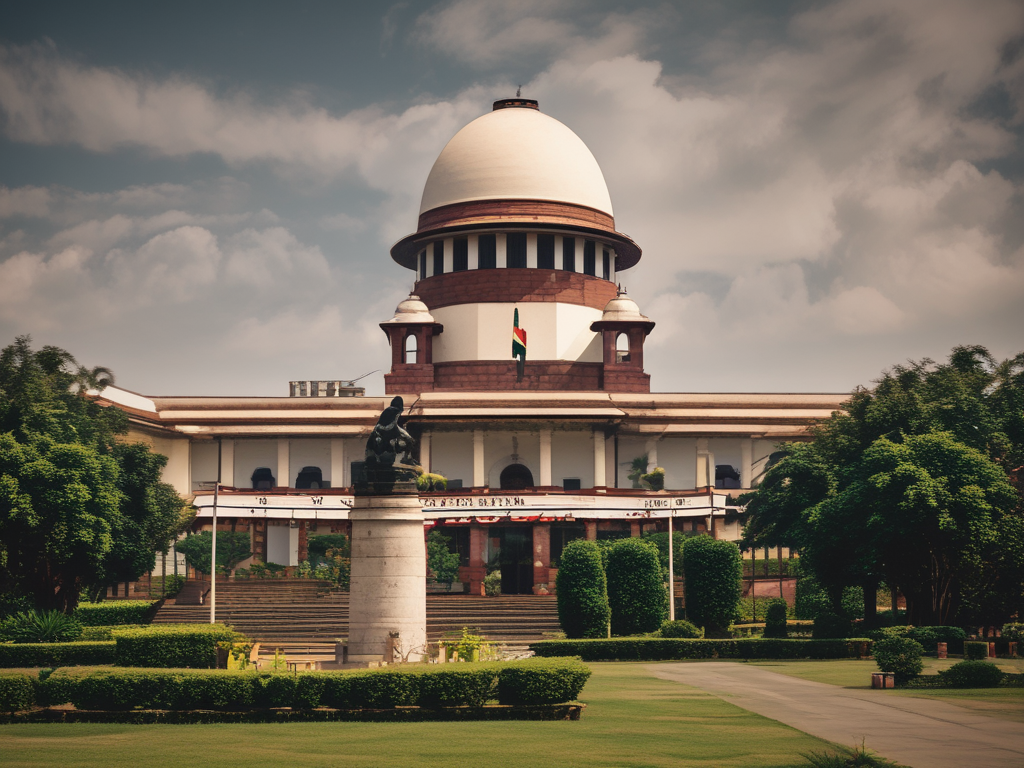
Supreme Court of India vide its judgment dated 11th December 2023 in Writ Petition (Civil) No. 1099 of 2019 clubbed with other petition, decided questions regarding constitutionality of abrogating Article 370 of the Constitution of India which incorporated special arrangements for the governance of the State of Jammu and Kashmir.
Issues Before The Supreme Court:
The five judges bench of Apex Court deliberated on following issues:
a. Whether the provisions of Article 370 were temporary in nature or whether they acquired a status of permanence in the Constitution;
b. Whether the amendment to Article 367 in exercise of the power under Article 370(1)(d) so as to substitute the reference to the “Constituent Assembly of the State referred to in clause (3) of Article 370 by the words “Legislative Assembly of the State” is constitutionally valid;
c. Whether the entire Constitution of India could have been applied to the State of Jammu and Kashmir in exercise of the power under Article 370(1)(d);
d. Whether the abrogation of Article 370 by the President in exercise of the power under Article 370(3) is constitutionally invalid in the absence of a recommendation of the Constituent Assembly of the State of Jammu and Kashmir as mandated by the proviso to clause (3);
e. Whether the proclamation of the Governor dated 20 June 2018 in exercise of power conferred by Section 92 of the Constitution of Jammu and Kashmir and the subsequent exercise of power on 21 November 2018, under Section 53(2) of the Constitution of Jammu and Kashmir to dissolve the Legislative Assembly are constitutionally valid;
f. Whether the Proclamation which was issued by the President under Article 356 of the Constitution on 19 December 2018 and the subsequent extensions are constitutionally valid;
g. Whether the Jammu and Kashmir Reorganisation Act 2019 by which the State of Jammu and Kashmir was bifurcated into two Union Territories (Union Territory of Jammu and Kashmir and Union Territory of Ladakh) is constitutionally valid bearing in mind: The first proviso to Article 3 which requires that a Bill affecting the area, boundaries or name of a State has to be referred to the legislature of the State for its views; and The second proviso to Article 3 which requires the consent of the State legislature for increasing or diminishing the area of the State of Jammu and Kashmir or altering the name of boundary of the State before the introduction of the Bill in Parliament;
h. Whether during the tenure of a Proclamation under Article 356, and when the Legislative Assembly of the State is either dissolved or is in suspended animation the status of the State of Jammu and Kashmir as a State under Article 1(3)(a) of the Constitution and its conversion into a Union Territory under Article 1(3)(b) constitutes a valid exercise of power.
The Decision:
In brief, Supreme Court held:
a. The State of Jammu and Kashmir does not retain any element of sovereignty after the execution of the IoA and the issuance of the Proclamation dated 25 November 1949 by which the Constitution of India was adopted. The State of Jammu and Kashmir does not have ‘internal sovereignty’ which is distinguishable from the powers and privileges enjoyed by other States in the country. Article 370 was a feature of asymmetric federalism and not sovereignty;
b) The petitioners did not challenge the issuance of the Proclamations under Section 92 of the Jammu and Kashmir Constitution and Article 356 of the Indian Constitution until the special status of Jammu and Kashmir was abrogated. The challenge to the Proclamations does not merit adjudication because the principal challenge is to the actions which were taken after the Proclamation was issued;
c) The exercise of power by the President after the Proclamation under Article 356 is issued is subject to judicial review. The exercise of power by the President must have a reasonable nexus with the object of the Proclamation. The person challenging the exercise of power must prima facie establish that it is a mala fide or extraneous exercise of power. Once a prima facie case is made, the onus shifts to the Union to justify the exercise of such power
d) The power of Parliament under Article 356(1)(b) to exercise the powers of the Legislature of the State cannot be restricted to law-making power thereby excluding non-law making power of the Legislature of the State. Such an interpretation would amount to reading in a limitation into the provision contrary to the text of the Article
e) It can be garnered from the historical context for the inclusion of Article 370 and the placement of Article 370 in Part XXI of the Constitution that it is a temporary provision
f) The power under Article 370(3) did not cease to exist upon the dissolution of the Constituent Assembly of Jammu and Kashmir. When the Constituent Assembly was dissolved, only the transitional power recognised in the proviso to Article 370(3) which empowered the Constituent Assembly to make its recommendations ceased to exist. It did not affect the power held by the President under Article 370(3);
g) The exercise of power by the President under Article 370(1)(d) to issue Order is not mala fide. The President in exercise of power under Article 370(3) can unilaterally issue a notification that Article 370 ceases to exist. The President did not have to secure the concurrence of the Government of the State or Union Government acting on behalf of the State Government under the second proviso to Article 370(1)(d) while applying all the provisions of the Constitution to Jammu and Kashmir because such an exercise of power has the same effect as an exercise of power under Article 370(3) for which the concurrence or collaboration with the State Government was not required
h) Paragraph 2 of Order issued by the President in exercise of power under Article 370(1)(d) applying all the provisions of the Constitution of India to the State of Jammu and Kashmir is valid. Such an exercise of power is not mala fide merely because all the provisions were applied together without following a piece-meal approach;
i) The President had the power to issue a notification declaring that Article 370(3) ceases to operate without the recommendation of the Constituent Assembly. The continuous exercise of power under Article 370(1) by the President indicates that the gradual process of constitutional integration was ongoing. The declaration issued by the President under Article 370(3) is a culmination of the process of integration and as such is a valid exercise of power. Thus, such Order issued is valid.

 LAW-IP AND MORE