
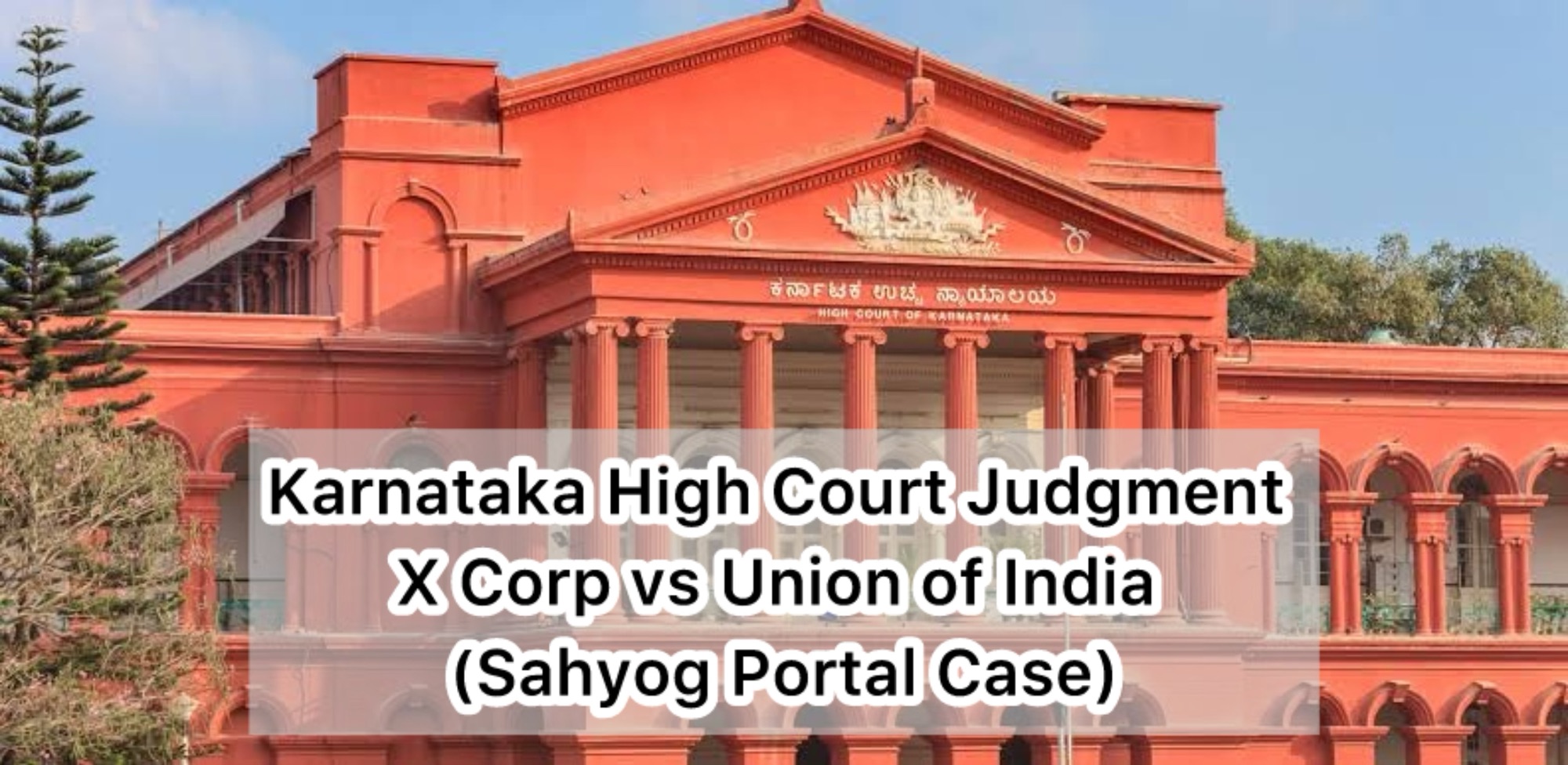
The dispute between X Corp (formerly Twitter, owned by Elon Musk) and the Government of India highlights the tension around social media regulation in India. At the heart of the controversy is the Sahyog portal, a centralised system for issuing content takedown orders against unlawful or harmful online posts. Here is the chronological explanation of the issue.
The foundation of India’s digital regulation lies in the Information Technology Act, 2000 (IT Act). Section 69A of IT Act empowers the government to block online content but requires procedural safeguards,
Section 69A:
Power to issue directions for blocking for public access of any information through any computer resource.
(1) Where the Central Government or any of its officers specially authorised by it in this behalf is satisfied that it is necessary or expedient so to do, in the interest of sovereignty and integrity of India, defence of India, security of the State, friendly relations with foreign States or public order or for preventing incitement to the commission of any cognizable offence relating to above, it may subject to the provisions of sub-section (2), for reasons to be recorded in writing, by order, direct any agency of the Government or intermediary to block for access by the public or cause to be blocked for access by the public any information generated, transmitted, received, stored or hosted in any computer resource.
(2) The procedure and safeguards subject to which such blocking for access by the public may be carried out, shall be such as may be prescribed.
(3) The intermediary who fails to comply with the direction issued under sub-section (1) shall be punished with an imprisonment for a term which may extend to seven years and also be liable to fine.
While section 69A gives government the authority to block content, Section 79 the said Act, grants safe harbour protection to intermediaries like Twitter, Facebook, and Instagram, provided they comply with certain obligations.
This means that platforms like X, Facebook, or Instagram are not held legally liable for the content posted by their users, provided they follow certain due diligence requirements laid down by law.
Section 79: Exemption from liability of intermediary in certain cases.–
(1) Notwithstanding anything contained in any law for the time being in force but subject to the provisions of sub-sections (2) and (3), an intermediary shall not be liable for any third party information, data, or communication link made available or hosted by him.
(2) The provisions of sub-section (1) shall apply if–
(a) the function of the intermediary is limited to providing access to a communication system over which information made available by third parties is transmitted or temporarily stored or hosted; or
(b) the intermediary does not–
(i) initiate the transmission,
(ii) select the receiver of the transmission, and
(iii) select or modify the information contained in the transmission;
(c) the intermediary observes due diligence while discharging his duties under this Act and also observes such other guidelines as the Central Government may prescribe in this behalf.
(3) The provisions of sub-section (1) shall not apply if–
(a) the intermediary has conspired or abetted or aided or induced, whether by threats or promise or otherwise in the commission of the unlawful act;
(b) upon receiving actual knowledge, or on being notified by the appropriate Government or its agency that any information, data or communication link residing in or connected to a computer resource controlled by the intermediary is being used to commit the unlawful act, the intermediary fails to expeditiously remove or disable access to that material on that resource without vitiating the evidence in any manner.
Thus this immunity under section 79 is not absolute, if an intermediary fails to act on valid government or court orders to remove unlawful content, it can lose this protection and be held responsible for the objectionable material hosted on its platform
The 2015 Supreme Court Judgment in Shreya Singhal v. Union of India, is vital to this discussion as it became a turning point in India’s digital speech jurisprudence. The challenge arose against Section 66A of the IT Act, which criminalised sending “grossly offensive,” “annoying,” or “menacing” messages online.
The vague wording of the law led to arbitrary arrests of citizens, including two young women in Maharashtra who were detained over a Facebook post. A law student Shreya Singhal filed a Public Interest Litigation before the Supreme Court, arguing that Section 66A violated the constitutional right to freedom of speech under Article 19(1)(a) of Constitution of India and could not be justified under the “reasonable restrictions” of Article 19(2).
By this judgment, the Supreme Court struck down Section 66A as unconstitutional, holding that the provision was vague and overly broad,. The Court made it clear that only speech which falls within the specific grounds of Article 19(2), such as public order, defamation, or national security can be restricted. At the same time, the Court clarified that intermediaries like social media platforms are required to remove content only when directed by a court or a government authority under Section 69A of the IT Act, thereby ensuring procedural safeguards against arbitrary censorship. This ruling remains the cornerstone for all subsequent debates on online free expression and intermediary liability in India, including the ongoing controversy over the government’s Sahyog portal.
2021 witnessed the regulatory framework tightened when the government notified the Information Technology (Intermediary Guidelines and Digital Media Ethics Code) Rules, 2021. These rules introduced strict requirements such as faster takedowns, grievance redressal mechanisms, and traceability of messages. While the government justified the rules as essential for accountability, major platforms expressed concerns about it’s overreach.
In October 2024, The Union Home Ministry launched the “Sahyog” portal, an online platform for government agencies and law enforcement to coordinate with social media intermediaries for content takedowns. Critics argued that the portal created a “parallel mechanism” for censorship, bypassing the procedural safeguards built into Section 69A.
In March 2025, X Corp. (formerly Twitter) filed a petition before the Karnataka High Court challenging the legality of the Sahyog portal. It argued that Sahyog was ultra vires the IT Act 2000, inconsistent with the Supreme Court’s Shreya Singhal ruling, and a violation of users’ right to free expression under Article 19(1)(a) of the Indian Constitution.
The government, however, defended the system as lawful, necessary to combat misinformation and unlawful content, and insisted that foreign companies like X Corp cannot invoke Article 19 rights meant for Indian citizens.
On September 24, 2025, the Karnataka High Court ruled in favour of the government and dismissed X Corp’s petition. The court upheld the legality of the Sahyog portal under Section 79(3)(b) and the IT Rules, 2021, stressing that social media platforms in India must accept regulation.
The court emphasised the necessity of regulating social media, particularly concerning offenses against women, stating that online freedom must be balanced with responsibility. The judgment underlined that foreign intermediaries cannot claim constitutional free speech rights in India.
Following the adverse judgment in the Karnataka High Court, X Corp. has the option to appeal against the ruling.

 LAW-IP AND MORE