
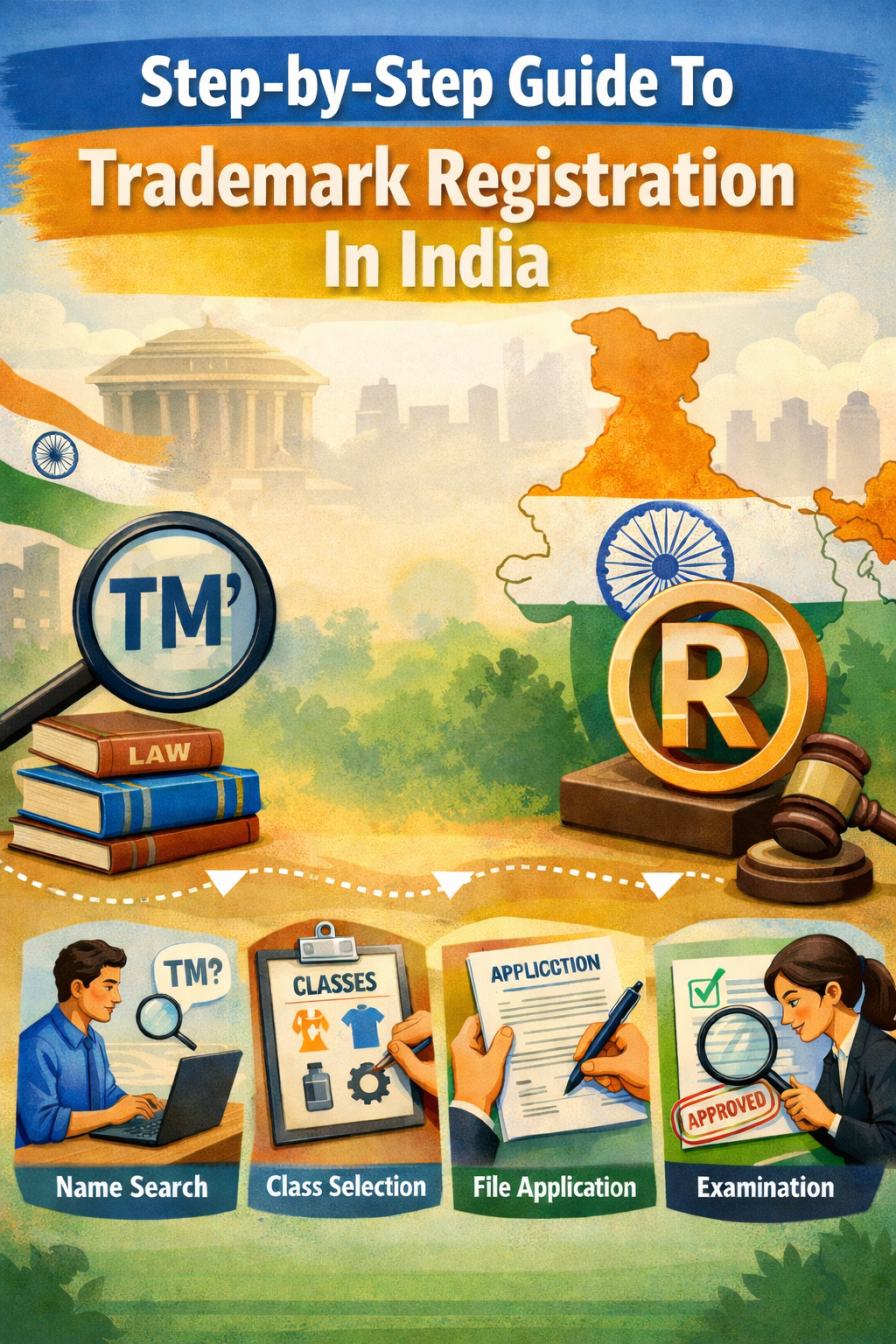
A business name, logo, or brand identity is often treated as a marketing asset. In law, however, it is something far more fragile. Until registered, it remains vulnerable, capable of being adopted, challenged, or even legally appropriated by another party. Trademark registration is not merely procedural compliance. It is the process through which a business converts reputation into an enforceable legal monopoly. This guide explains the actual legal process of trademark registration in India.
Get Help Now – Register Your Brand With:
•Comprehensive trademark Search •Class selection and Strategy
•Objection and hearing support
•End-to-end legal handling
Connect with us on WhatsApp
The trademark registration process in India is a crucial step for businesses and individuals who wish to protect their brand identity. Governed by the Trade Marks Act, 1999, it ensures that logos, names, symbols, or taglines that distinguish goods or services are legally safeguarded against misuse.
The entire Trademark Registration Process often ends up being much more complex than generally understood and might require legal attention at various stage of the process. Following are the various stages in concise form for better understanding.
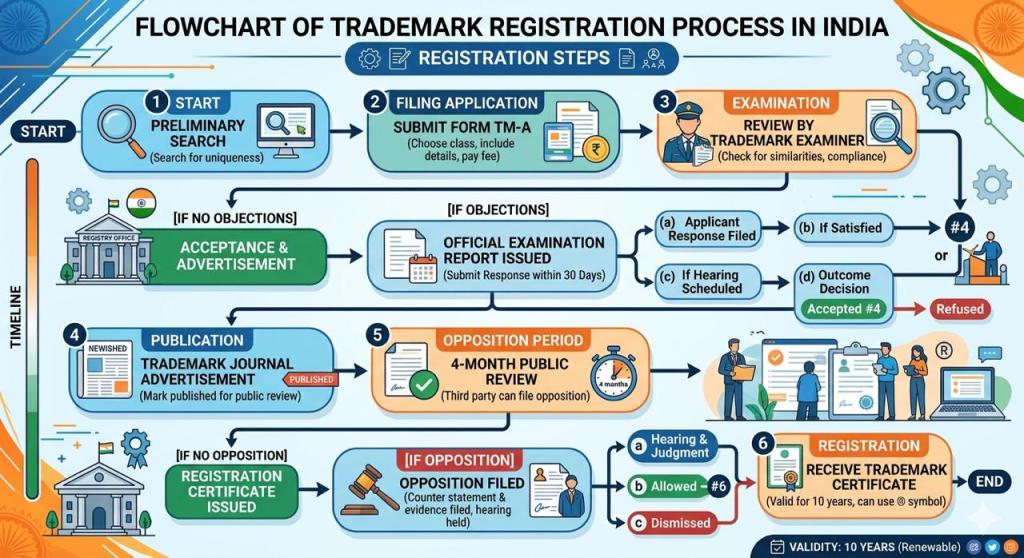
Trademark Search: The process begins with a trademark search on the official IP India website to check whether the proposed mark is unique and not already in use. This step helps avoid conflicts and saves time during registration.
Trademark Application: Once the search confirms availability, the next step is to file a trademark application in form TM-A online or offline with the Trade Marks Registry by submitting the applicant’s details, class number in which goods or services belongs, and a clear representation of the trademark alongwith govt. fees. The govt. fees differs according to the category in which the Applicant belongs to. For Individual/Startup/Small enterprise the govt. fees for online filing is ₹ 4,500/- and for other cases it is ₹ 9,000/-
Examination & Objection: After filing, the application goes through examination by the Registrar, who checks for compliance with legal provisions and identifies any similarity with existing trademarks. If objections arise, the applicant must submit a legally sound written reply and if required also attend a hearing to clarify their case.
Publication & Grant: Once the application passes this stage, it is published in the Trade Marks Journal for a period of four months. This allows third parties to file an opposition if they believe the mark infringes on their rights. If no opposition is filed, or if the matter is resolved in favor of the applicant, the trademark proceeds to registration.
Registration & Renewal: On successful registration, the applicant receives a trademark registration certificate, granting them exclusive rights to use the mark for the specified goods or services. The trademark remains valid for 10 years from the date of application and can be renewed indefinitely in further blocks of ten years with timely renewal applications.
Information Required for Filing a Trademark Application:
Hence, trademark application in India typically proceeds to registration over a span of roughly six to seven months, subject to procedural compliance and absence of objections or oppositions.
To initiate a trademark application in India, the following particulars and documents are required:
Core Requirements
- The trademark, logo, or word mark proposed for registration
- Details of the applicant, including name, address, and nationality; in the case of a company, the jurisdiction of incorporation
- Nature of the applicant entity, whether individual, startup/small enterprise, or other entity category
- The relevant class along with a clear specification of goods or services
- A duly executed power of attorney in favour of the authorised representative
Additional Requirements in Case of Prior Use or Convention Applications
- The date on which the trademark was first used in India, where prior use is claimed
- An affidavit affirming such prior use, supported by documentary evidence establishing commercial use of the mark
- Priority claim details, including application number, filing date, and country of origin, where applicable
- A certified copy of the priority document in convention-based filings
Clarification on Formal Documentation
Affidavit of Use
Under the Trade Marks Rules, 2017, any application asserting prior use must be accompanied by a sworn affidavit substantiating such use. This affidavit must be filed together with documentary evidence demonstrating actual and continuous use of the mark in relation to the specified goods or services in India.
Power of Attorney
A power of attorney authorising representation is required at the time of filing. This document may be executed by any duly authorised signatory of the applicant entity. Notarisation or legalisation is not mandated.
Priority Documents
Where a priority claim is invoked based on a convention application, a certified copy of the priority document must be submitted. In the event of non-submission at the time of filing, the Trade Marks Registry may issue a formal notice requiring submission within the prescribed period.
Registering a trademark not only provides legal protection but also helps in building brand recognition, consumer trust, and a stronger market presence. For entrepreneurs, startups, and established companies alike, understanding how to register a trademark in India is essential for long-term brand security.

 LAW-IP AND MORE