
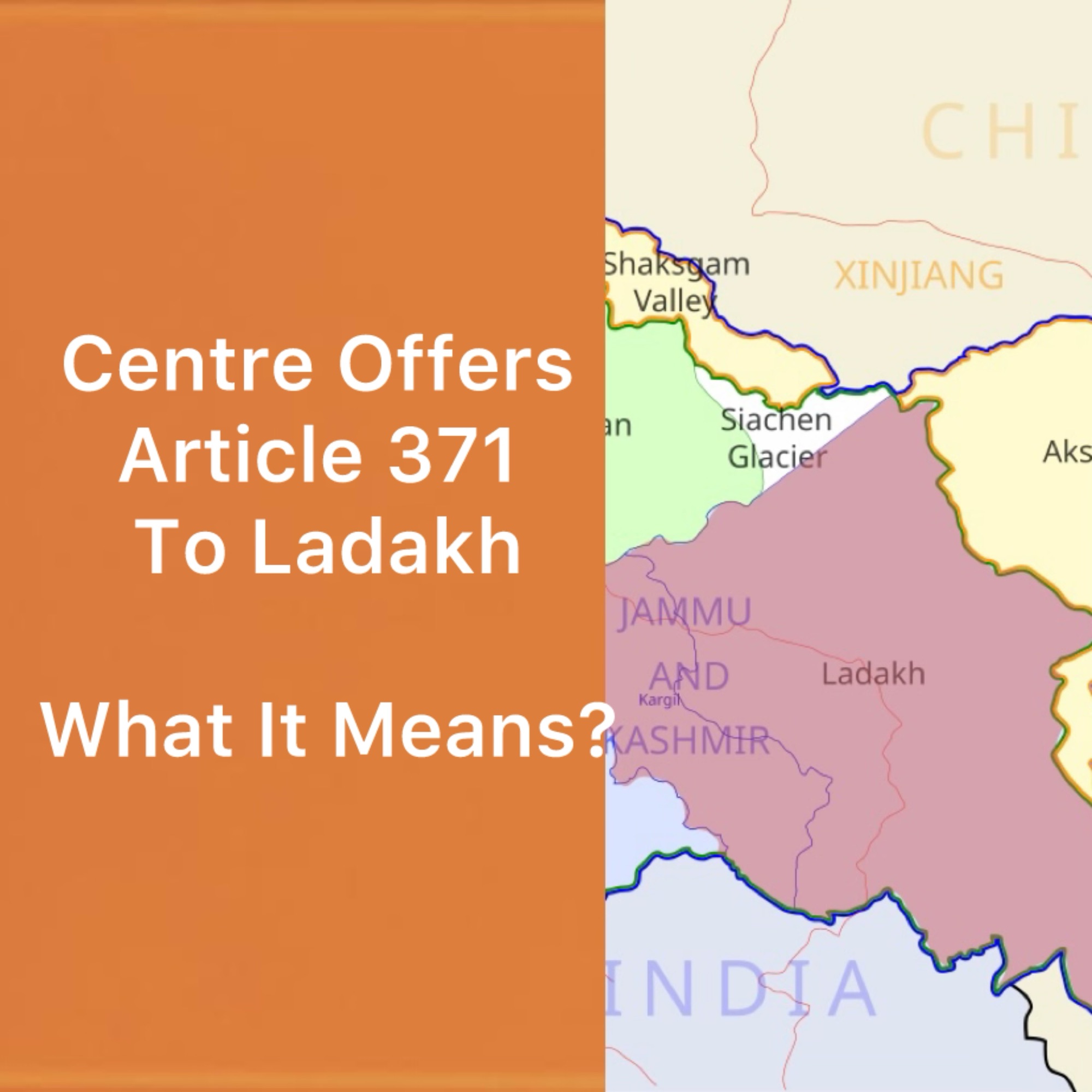
As per new reports, in recent talks, the central government has indicated that it could consider extending Article 371 special provisions to Ladakh, as a possible way to address the demands. The Ladakhi groups (LAB, KDA) continue to demand statehood plus Sixth Schedule status. Here’s a breakdown of what’s going on and what the offer from the Ministry of Home Affairs (MHA) means
On 31st October 2019, the former state of Jammu & Kashmir was reorganised under the Jammu & Kashmir Reorganisation Act, 2019 into two Union Territories (UTs), one being Ladakh. Unlike some UTs, Ladakh does not have its own legislative assembly. It is directly administered by a Lieutenant Governor and central government.
Local groups in Ladakh, notably the Leh Apex Body (LAB) and the Kargil Democratic Alliance (KDA), have demanded statehood for Ladakh (i.e., become a state, with its own legislature) and inclusion under the Sixth Schedule of the Constitution of India (which provides for special autonomous district/tribal councils) to protect land, jobs, culture and resources.
The major unrest on 24 September 2025 due to protests in Leh led to four people being killed in clashes with police. This escalated urgency for talks. Following that, the central government resumed talks with Ladakhi groups after a break, to discuss constitutional safeguards.
What is Article 371 of the Constitution of India?
Article 371 of the Indian Constitution contains special provisions for several states to address their unique developmental, cultural and security concerns. This Article allows for “asymmetric federalism,” where not all states are treated equally, and special arrangements are made to accommodate their specific needs within the broader framework of the Indian Union. While Article 371 was part of the original Constitution for Maharashtra and Gujarat, other states were added through subsequent amendments, with provisions ranging from Article 371A to 371J
Article 371 has provided “temporary, transitional and special arrangements” for specific states in India (mostly in the north-east) to protect local interests such as land, culture and jobs. It gives powers such as, local legislation for specified areas, additional protection for customary laws, control over land-ownership or transfer etc in some states. It is less extensive than the Sixth Schedule autonomy. Sixth Schedule provides for democratic bodies (Autonomous District Councils) with legislative, judicial and executive powers in tribal areas.
Article 371 could address various Ladakhi concerns such as protection of land and resources from outside settlement/investment, given strategic, ecological and cultural sensitivity of the region, priority for locals in jobs, who gets domicile status, who can apply for jobs, local governance and decision-making etc
Offering Article 371 may be seen as bringing constitutional guarantee of better protection. If granted, possible implications include, Ladakh getting legal protection for land, jobs, maybe stronger local councils, maybe legislative powers for certain areas. That would strengthen safeguards for locals. It will not make Ladakh a State (it would remain UT). For the central government this might be a way to defuse unrest in Ladakh by offering something substantive, without committing to full statehood which could mean many logistical, political, strategic implications.
As talks between the Ministry of Home Affairs (MHA) and Ladakhi leaders continue, the future of Ladakh hangs in the balance. Extending Article 371 could bring long-awaited constitutional protections and help calm tensions in the region, the outcome will shape not only Ladakh’s governance but also India’s broader approach to balancing national control with regional aspirations.


