
Every work of art has three aspects tying it to its creator , the “right to own it”, the “right to be recognised for it”, and the “right to perform it”. In law, these are called “copyright”, “moral rights”, and “performer’s rights” respectively. Together they governs how creative works are owned, shared, and remembered.
Copyright law is designed to protect originality, to ensure that the person who creates a melody, writes a poem, or paints a canvas can control its use. For example, when a musician composes an original score for a film, or when a painter paints a canvas, their creations are protected as copyright works.
Under the Copyright Act, 1957, this protection lasts for 60 years after the author’s death, allowing the creator (or their heirs) to control how the work is used, licensed, or reproduced.
Moral rights, on the other hand, evolved to preserve the bond of honour between an author and their work, even when they no longer own the economic rights.
For instance, a painter after selling the painting or a singer in Indian movie album, , still retained the right to be recognised as its creator and to object if the art-work was distorted or defaced.
These rights, defined under Section 57, also last for the author’s lifetime plus 60 years, ensuring that reputation outlives ownership.
Performer’s rights came later, acknowledging that an artist’s live expression, the voice that brings a song to life, also deserves protection. When Lata Mangeshkar sang a composition, or a classical dancer performs a piece, their performance itself becomes a creative act.
Under Sections 38 to 38B, performers enjoy rights over their recorded performances for 50 years from the year of performance, including the right to be identified and to prevent unauthorised recordings or distortions.
Indian Classical Rendition-Copyright And Performer’s Rights
Each of the discussed three rights spring from the same root, yet their boundaries often blur. When we look at the Indian classical reditions, the question arises that what happens when art is not created in isolation but drawn from centuries of tradition? Can an artist claim copyright over a raga, a chant, or a hymn that has travelled through generations? Does originality lie in the composition, or in the performance that reinterprets it?
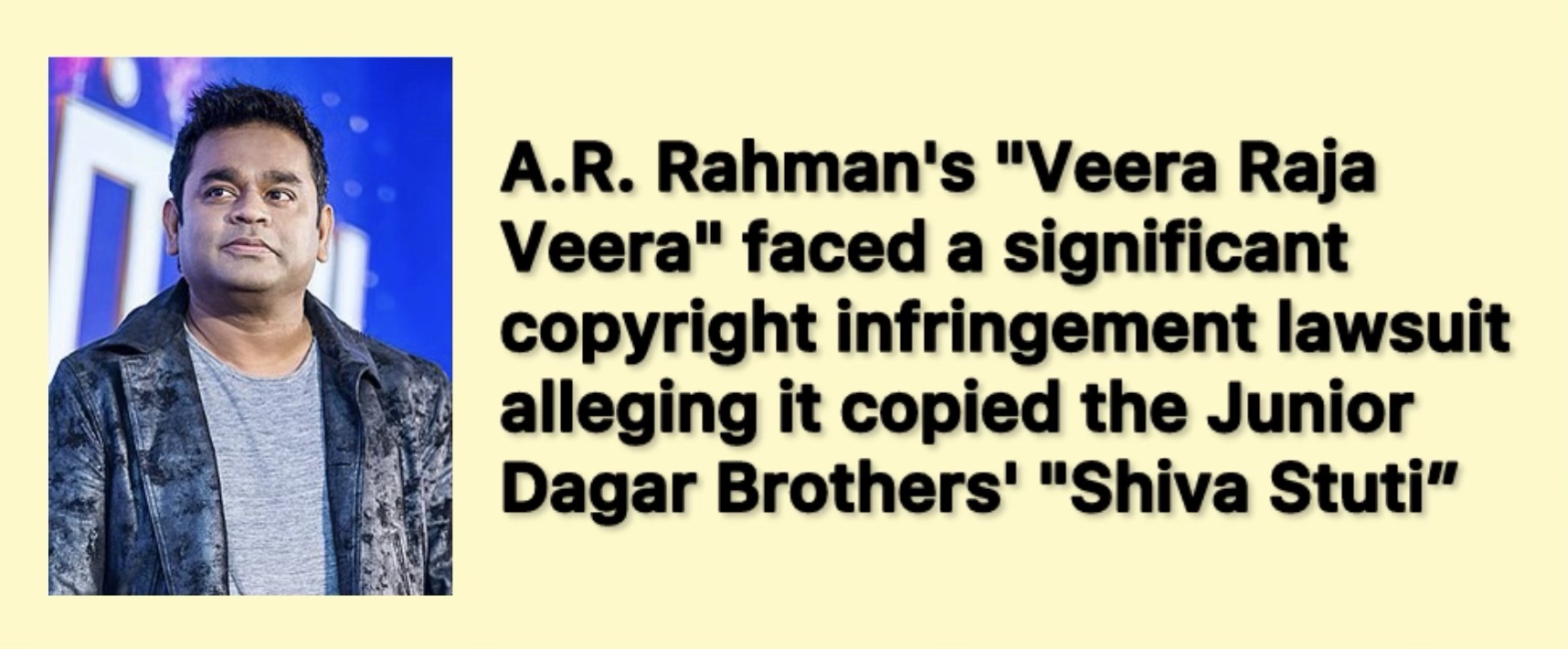
The case before Delhi High Court involving dispute between A.R. Rahman and Faiyaz Wasifuddin Daga, questioned who truly owns music born from heritage.
The controversy centred around the celebrated song “Veera Raja Veera” from Ponniyin Selvan II, composed by Rahman, and an old Dhrupad piece “Shiva Stuti,” performed decades earlier by the legendary Junior Dagar brothers. The Dagar family claimed that Rahman’s composition reproduced their work almost note for note.
Initially, the Delhi High Court agreed and directed Rahman and his producers to deposit ₹2 crore and credit the Dagars in the film. But the Division Bench later reversed this, holding that while the Dagars had performed the piece, they had not proved they “composed” it.
That distinction lies at the heart of copyright.
Under the “Copyright Act, 1957”, the “author” of a musical work , the composer , owns the right to reproduce and adapt it. If the work is part of an ancient or traditional repertoire, it belongs to the “public domain”. The court found that “Shiva Stuti” was a Dhrupad chant handed down through generations, not a private creation. Hence, no exclusive copyright could exist. Rahman’s composition, even if inspired by the same tradition, was therefore legally independent.
This ruling brought to light a subtle but crucial truth about creativity, that authorship and performance, though intertwined, are not the same. The law draws a fine line between creating a work and expressing it. While copyright guards the composer’s structure of notes, rhythm, and arrangement, it does not extend to the individuality of a performance that brings those notes to life. It is in this space between authorship and interpretation that performers’ rights find their voice.
Performers’ rights, introduced in “1994” and strengthened in “2012”, protect a different kind of creativity, the “interpretation”. When a singer, dancer, or instrumentalist performs a work, they invest originality in tone, rhythm, and emotion. Sections 38 to 38B grant them rights to be identified as the performer, to prevent distortion of their recorded performance, and in some cases, to share royalties. But these rights do not make them the authors of the composition itself. The Dagar family’s claim, was caught in this distinction, they were heirs to great performers, not proven composers.
Running parallel to both Copyright and Performer’s rights is the doctrine of “moral rights” under “Section 57” , a uniquely personal safeguard that survives even after copyright transfer. Moral rights protect an author’s connection to their work through two principles, the right of “paternity” (to be credited) and the right of “integrity” (to prevent distortion). It was this moral impulse that led the single judge in the Rahman dispute to order that the Junior Dagar brothers be credited in the film.
Later when the appellate court examined the issue, it held that moral rights arise only if authorship is first established. Without proof of who composed “Shiva Stuti”, the claim to moral authorship could not stand.
Each right operates within its own register. “Copyright” secures authorship and commercial control. “Performers’ rights” celebrate expression and performance. “Moral rights” preserve honour and attribution. In a country like India , where art often flows through oral traditions and collective memory, identifying authorship can be legally complex and emotionally charged. Folk songs, classical ragas, and devotional hymns belong to everyone and to no one at once, leaving courts to walk a fine line between preserving heritage and rewarding innovation.
For today’s creators, the lesson is clear. Document authorship with precision , notations, recordings, and dated drafts establish originality better than memory. Acknowledge influences, even if the law does not compel it, cultural respect often prevents legal conflict. When collaborating, define who is the composer, lyricist, and performer and most importantly copyright registration is the demand of the changing times.


