
As countries grapple with how to regulate the fast-expanding world of artificial intelligence, a global debate has emerged on the ethical, economic, and legal implications of using copyrighted material for AI training. From the United States to the European Union, policymakers, creators, and technology companies are engaged in ongoing discussions about how to balance innovation with the rights of authors and artists.
This international conversation forms an important backdrop for India’s own policy shift, providing context for the country’s attempt to craft a structured, fair, and forward-looking approach. It is against this evolving global landscape that India proposes a new AI royalty framework for OpenAI, Google, and other developers by introducing an important policy proposal aimed at creating a fair and transparent system for the use of copyrighted Indian content in AI training.India proposes new AI royalty framework for OpenAI, Google, and other developers by introducing an important policy proposal aimed at creating a fair and transparent system for the use of copyrighted Indian content in AI training.
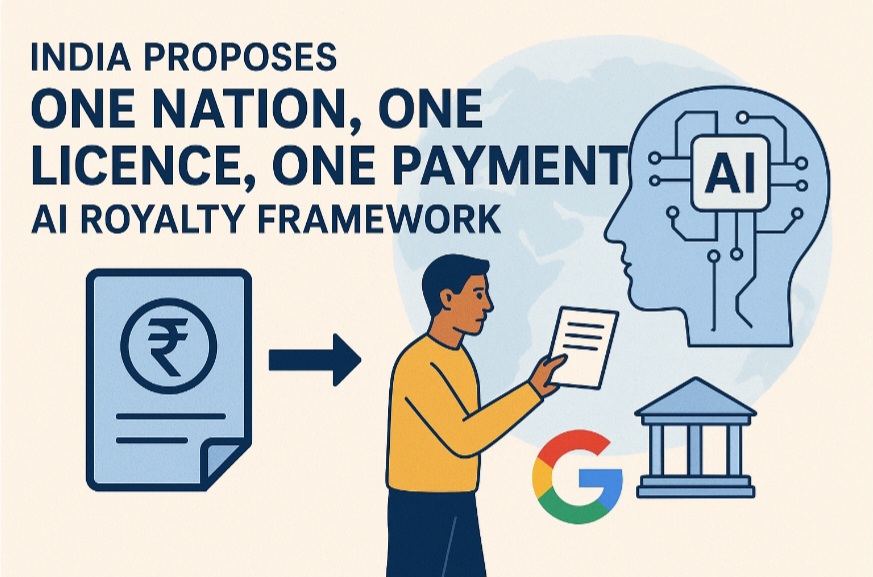
The Department for Promotion of Industry and Internal Trade (DPIIT) has released a working paper that proposes a new “One Nation, One Licence, One Payment” mandatory royalty framework for AI companies using copyrighted content for training. A government-appointed expert panel has recommended that companies such as OpenAI and Google should pay royalties when their AI models are trained using books, articles, music, films, photographs, and other protected works.
Unlicensed use of copyrighted material for training AI systems raises genuine concerns under copyright law. A blanket statutory exception allowing AI developers to freely use such material without the creators consent would tilt the balance too far in favour of AI companies, eventually discouraging the creation of new human generated works. AI itself cannot thrive without fresh human creativity, since relying on the same old datasets would limit its growth. Therefore, to support cultural progress, maintain incentives for human creators, and enable the development of effective AI systems, a balanced legal approach is necessary.
The most suitable solution is a framework that guarantees fair compensation to copyright holders while still allowing AI developers broad and practical access to training data. The proposal is built around a “One Nation, One Licence, One Payment” approach. Instead of requiring separate agreements with each creator, AI companies would contribute to a central licensing fund. This fund would then distribute royalties to authors, artists, journalists, and other rights-holders whose content supports the development of AI systems.India’s model is distinctive globally. In the United States, AI training on publicly available material is often treated as fair use, meaning no royalty obligations.
In the European Union, creators can opt out, but payments are not compulsory. India’s framework focuses on ensuring fair compensation in a structured and predictable manner.Creative communities have welcomed the proposal as a step toward protecting their work in the AI era, while some technology groups are evaluating its potential impact on innovation. The government has opened the proposal for public comments before finalizing the policy.

 LAW-IP AND MORE