
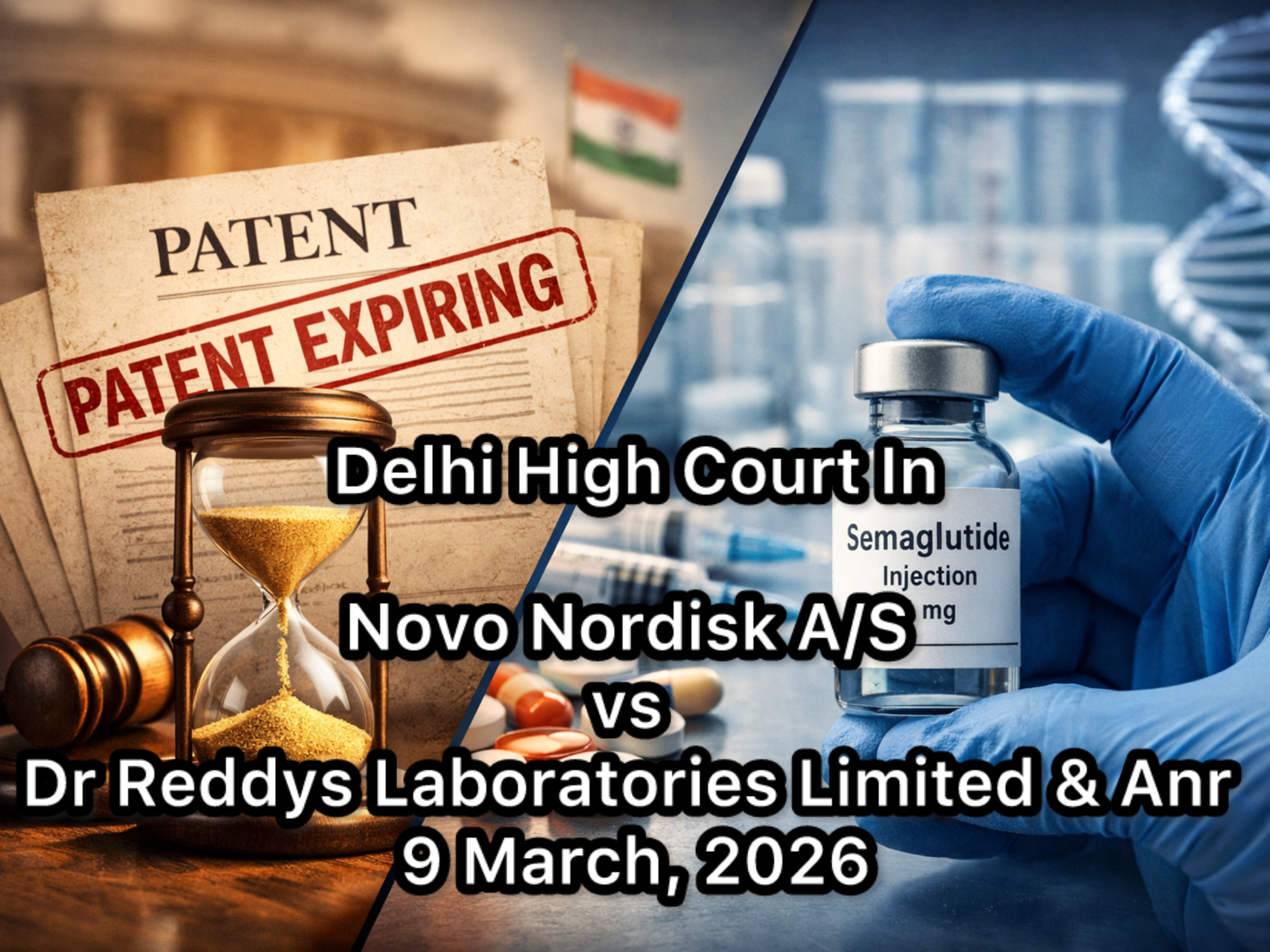
In Pharma patent disputes the closer a patent moves towards expiry, the more pressing becomes the question whether injunctive relief continues to serve any meaningful legal purpose.
The issue before the Delhi High Court Division Bench was whether refusal of interim injunction in a patent infringement action warranted appellate interference, where a validity challenge had been raised and the patent was nearing expiry.
Essential Facts
The appellant asserted infringement of its patent covering Semaglutide. The respondents did not seriously contest acts amounting to infringement, but resisted relief by invoking invalidity under Section 64.
The learned Single Judge found a credible challenge to validity and declined injunction. By the time of appeal, the patent had approximately two months of life remaining.
The governing principles are settled:
•defendant may rely on any ground under Section 64 as a defence under Section 107
•At the interim stage, a credible challenge suffices
•Appellate review of such orders is limited by the Wander standard, permitting interference only where discretion is exercised perversely or contrary to law.
The analysis engages:
- Section 48, conferring exclusive rights
- Section 64(1)(a), (e), (f), governing revocation
- Section 107(1), incorporating these grounds as defences
The Court underscores a critical distinction, Section 64(1)(a) requires strict claim identity, whereas Sections 64(1)(e) and (f) operate through broader concepts of anticipation and obviousness.
Court’s Reasoning
The Court declines interference on two interlinked grounds.
First, applying the Wander principle, it finds no error in the exercise of discretion by the Single Judge.
Second, it affirms that a credible challenge to validity exists under Section 64(1)(f). The prior art disclosed the structural framework from which the claimed invention could be derived through a substitution already contemplated within its teaching. This, in the Court’s view, rendered the invention prima facie obvious to a person skilled in the art, or more appropriately, a “person in the know”.
Crucially, the Court introduces an additional consideration. With the patent on the verge of expiry, the grant of injunction would yield no substantive or enduring benefit, thereby undermining the claim of irreparable harm.
The judgment performs two important clarificatory functions.
It restores doctrinal precision by separating anticipation by prior claiming from obviousness, rejecting any attempt to collapse the former into an enabling disclosure analysis.
More significantly, it recalibrates the application of interim relief principles. While not altering the established triad governing injunctions, the Court integrates proximity to patent expiry into the assessment of irreparable injury and balance of convenience. This marks a shift from purely rights-based enforcement towards a more context-sensitive exercise of discretion.
The decision leaves open questions as to the extent to which proximity to expiry should systematically influence interim relief. It does not delineate whether such reasoning is confined to exceptional cases or capable of broader application.
Further, the relationship between residual patent value and equitable protection remains unexplored, particularly in high-value pharmaceutical markets.
The immediate consequence is a heightened threshold for obtaining interim injunctions in late-stage patent life. Patent holders may find exclusivity increasingly difficult to enforce as expiry approaches, especially where defendants can articulate a plausible invalidity challenge.
For defendants, the decision reinforces the strategic value of raising credible, even if not conclusive, validity objections at the interlocutory stage.
The judgment does not dilute patent rights, but places their interim enforcement within a framework that accounts for timing, utility, and judicial economy.
In doing so, it affirms that interlocutory relief in patent law is not merely a function of entitlement, but of contextual justification.
Leave your suggestion and comments on WhatsApp no. +91-8929203324

 LAW-IP AND MORE