
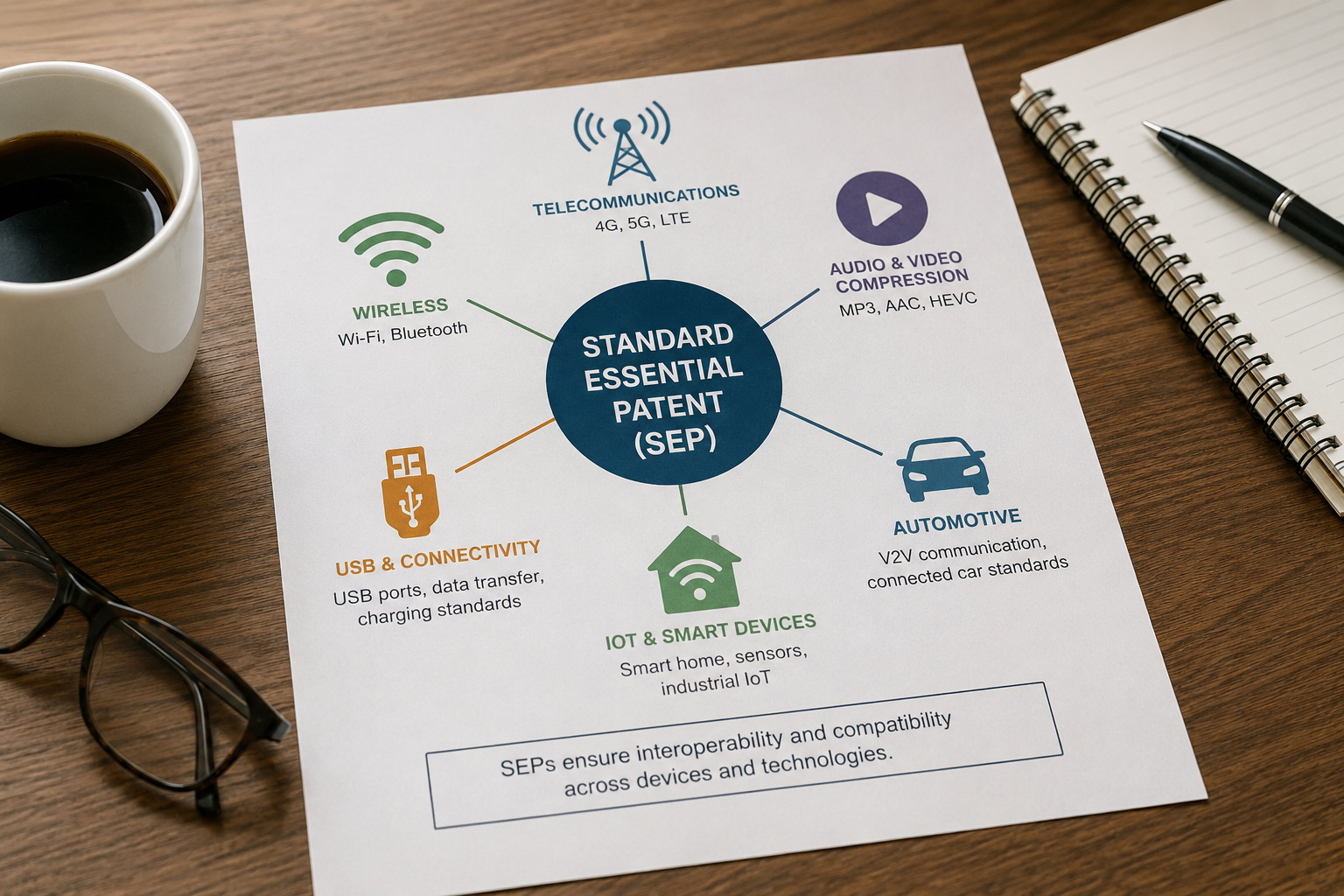
Modern technology depends not merely on innovation, but on standardization. Every day, billions of devices manufactured by different companies communicate seamlessly across networks, platforms, and borders. Smartphones connect to cellular towers, laptops access Wi-Fi networks, Bluetooth earphones pair instantly with mobile devices, and streaming services deliver compressed video content compatible across countless screens. Such interoperability is possible because industries adopt common technical standards. Behind many of these standards lies a highly significant category of intellectual property known as Standard Essential Patents (SEPs).
A Standard Essential Patent is a patent that protects a technology considered indispensable for implementing a technical standard adopted by a Standard Setting Organization (SSO). In simple terms, once a patented invention becomes part of an officially recognized technical standard, manufacturers complying with that standard may have no practical option but to use the patented technology. The patent thereby becomes “essential” to the standard itself. Unlike ordinary patents, which competitors may design around or avoid entirely, SEPs often become unavoidable for participation within a technological ecosystem.
To understand this distinction, it is useful to compare a conventional patent with an SEP. Suppose a company develops a new wireless signal processing method and obtains a patent over it. If manufacturers can continue producing devices without adopting that technology, the patent remains an ordinary patent. However, if a Standard Setting Organization later incorporates that technology into an official communication standard, such as a 5G protocol, every manufacturer seeking compliance with the standard may be required to implement the patented invention. At that stage, the patent acquires the status of a Standard Essential Patent.
SEPs are especially prominent in the telecommunications industry. Modern mobile communication systems, including 3G, 4G LTE, and 5G, operate through globally harmonized technical standards developed by organizations such as 3GPP and ITU. These standards define complex mechanisms relating to signal encoding, spectrum efficiency, network access, handovers between cellular towers, and data transmission protocols. Many of these technological solutions are patented. When incorporated into the standard, they become SEPs. Consequently, manufacturers producing standards-compliant mobile devices must obtain licenses to such patents. This explains why SEP disputes have become common among major technology companies such as Qualcomm, Ericsson, Nokia, and Huawei.
Wireless communication technologies provide another significant example of SEPs in practice. Wi-Fi standards developed under the IEEE 802.11 framework ensure that devices manufactured by different companies can communicate through common wireless protocols. If a patented method governing wireless synchronization, interference reduction, or packet transmission becomes integrated into the Wi-Fi standard, manufacturers of laptops, routers, smart televisions, and mobile devices may all require licenses to that patented technology. The same principle applies to Bluetooth standards governing short-range wireless communication between devices such as earphones, smartwatches, automobiles, and keyboards.
The role of SEPs extends far beyond telecommunications. Modern audio and video compression technologies also rely heavily on standardized systems. Formats such as MP3, AAC, and HEVC/H.265 enable efficient storage and transmission of multimedia data across devices and streaming platforms. These standards often incorporate patented compression algorithms designed to reduce bandwidth consumption while preserving quality. Once included within the standard, such patents become essential for compliant implementation. As a result, SEP licensing disputes frequently arise in industries involving smartphones, smart televisions, video conferencing platforms, and digital streaming services.
Hardware connectivity standards similarly involve SEP-related technologies. USB standards governing data transfer, charging protocols, and connector compatibility may incorporate patented communication or power management technologies. If compliance with the USB standard necessarily requires use of a patented invention, that patent may qualify as an SEP. This ensures that devices manufactured by different companies remain interoperable while simultaneously creating licensing obligations for implementers of the standard.
The automotive industry has also emerged as an important arena for SEP licensing. Modern vehicles increasingly function as connected digital systems equipped with navigation technologies, telematics, vehicle-to-vehicle communication systems, and internet-enabled services. Standards governing these technologies may incorporate patented communication protocols essential for interoperability and network compatibility. Consequently, automobile manufacturers such as Toyota, BMW, and Ford Motor Company have increasingly encountered SEP licensing negotiations and litigation.
Similarly, the expanding ecosystem of smart devices and the Internet of Things (IoT) depends upon standardized communication protocols enabling interoperability among connected products. Smart home devices, industrial sensors, wearable technologies, and intelligent appliances all rely on shared technical standards. If patented low-power communication technologies or synchronization methods become mandatory components of those standards, the underlying patents become standard-essential.
The legal significance of SEPs lies in the unique market power they can create. Ordinarily, a patent holder may freely decide whether to license its invention. However, where a patent becomes essential to an industry standard, refusal to license may effectively block competitors from participating in the market altogether. This creates the risk of excessive royalty demands, anti-competitive conduct, or exclusionary practices. To address these concerns, Standard Setting Organizations typically require SEP holders to commit to licensing their patents on FRAND terms, meaning Fair, Reasonable, and Non-Discriminatory terms.
The FRAND framework seeks to balance two competing objectives. On one hand, innovators must receive adequate incentives and compensation for their technological contributions. On the other hand, implementers of standards must retain fair access to essential technologies necessary for market participation and consumer interoperability. FRAND obligations therefore attempt to prevent both patent hold-up by SEP owners and strategic hold-out by implementers seeking to delay or avoid licensing obligations.
Today, Standard Essential Patents occupy a central position at the intersection of intellectual property law, competition law, technological governance, and global commerce. As industries become increasingly interconnected and dependent on standardized digital infrastructure, disputes relating to SEP licensing, royalty calculation, injunctions, and FRAND compliance are likely to grow in importance. In many respects, SEPs represent the legal architecture underlying the modern digital economy, enabling interoperability while simultaneously raising some of the most complex regulatory and commercial questions in contemporary patent law.


