
-
Patent Assignment and Proof of Right in India
Patent ownership is one of the most important yet frequently misunderstood aspects of Indian patent law. While inventors create inventions, patent applications are often filed by employers, corporations, research institutions, or assignees. In such situations, Indian patent law requires the applicant to establish its legal entitlement to file the patent application.
What Is Patent Assignment?
A patent assignment is the transfer of rights relating to an invention from one person to another. The transfer may occur before a patent is granted, in the form of an assignment of the right to apply for a patent, or after grant, in the form of an assignment of the patent itself.
Under Section 6(1)(b) of the Patents Act, 1970, an assignee of the true and first inventor is entitled to apply for a patent.
Proof of Right Under Section 7(2)
Where a patent application is filed by an assignee rather than the inventor, Section 7(2) requires the applicant to furnish proof of its right to make the application.
The provision does not prescribe a single mandatory form of evidence. The requirement is not merely to produce a particular document but to establish that the right to apply has validly vested in the applicant.
Traditionally, proof of right may be established through:
- Assignment deeds;
- Inventor declarations;
- Employment agreements;
- Corporate intellectual property policies;
- Other documentary evidence demonstrating transfer of rights.
Employment Agreements and Employer Ownership:
Modern innovation is frequently generated within corporations by employees acting in the course of their employment. In such cases, ownership of inventions often vests in the employer pursuant to employment contracts and company intellectual property regulations.
The Delhi High Court in Nippon Steel Corporation v. Controller of Patents (2025) clarified that a duly executed employment agreement, read together with company intellectual property policies and supporting declarations, can constitute sufficient proof of right under Section 7(2). The Court rejected the view that only a separate assignment deed could satisfy the statutory requirement.
A crucial distinction exists between:
- Assignment of the right to apply for a patent; and
- Assignment of a granted patent.
The former is governed principally by Sections 6 and 7 of the Patents Act. The latter falls within Section 68, which deals with assignments, licences, mortgages, and other interests in a granted patent.
Courts have repeatedly emphasized that Section 68 concerns transactions relating to an existing patent and should not be mechanically applied to pre-grant assignments of the right to apply.
The NEC Decision and Inventor Declarations:
In NEC Corporation v. Assistant Controller of Patents (2023), the Madras High Court clarified another important aspect of proof of right. The Court held that the date on which an inventor signs a declaration is not necessarily the date on which the assignment occurred.
A declaration may merely confirm a prior assignment. Patent authorities must therefore examine the substance of the evidence rather than rely solely upon dates appearing on declarations.
Practical Importance for Patent Applicants:
Patent applicants should ensure that documentary evidence establishing ownership is available at the time of filing or within the prescribed statutory period. Employment agreements, assignment deeds and internal intellectual property policies should be maintained carefully and produced whenever necessary. Applicants must maintain a clear documentary trail showing how rights passed from the inventor to the applicant.
-
What Are Standard Essential Patents? How Modern Technology Depends on SEPs
Modern technology depends not merely on innovation, but on standardization. Every day, billions of devices manufactured by different companies communicate seamlessly across networks, platforms, and borders. Smartphones connect to cellular towers, laptops access Wi-Fi networks, Bluetooth earphones pair instantly with mobile devices, and streaming services deliver compressed video content compatible across countless screens. Such interoperability is possible because industries adopt common technical standards. Behind many of these standards lies a highly significant category of intellectual property known as Standard Essential Patents (SEPs).
A Standard Essential Patent is a patent that protects a technology considered indispensable for implementing a technical standard adopted by a Standard Setting Organization (SSO). In simple terms, once a patented invention becomes part of an officially recognized technical standard, manufacturers complying with that standard may have no practical option but to use the patented technology. The patent thereby becomes “essential” to the standard itself. Unlike ordinary patents, which competitors may design around or avoid entirely, SEPs often become unavoidable for participation within a technological ecosystem.
To understand this distinction, it is useful to compare a conventional patent with an SEP. Suppose a company develops a new wireless signal processing method and obtains a patent over it. If manufacturers can continue producing devices without adopting that technology, the patent remains an ordinary patent. However, if a Standard Setting Organization later incorporates that technology into an official communication standard, such as a 5G protocol, every manufacturer seeking compliance with the standard may be required to implement the patented invention. At that stage, the patent acquires the status of a Standard Essential Patent.
SEPs are especially prominent in the telecommunications industry. Modern mobile communication systems, including 3G, 4G LTE, and 5G, operate through globally harmonized technical standards developed by organizations such as 3GPP and ITU. These standards define complex mechanisms relating to signal encoding, spectrum efficiency, network access, handovers between cellular towers, and data transmission protocols. Many of these technological solutions are patented. When incorporated into the standard, they become SEPs. Consequently, manufacturers producing standards-compliant mobile devices must obtain licenses to such patents. This explains why SEP disputes have become common among major technology companies such as Qualcomm, Ericsson, Nokia, and Huawei.
Wireless communication technologies provide another significant example of SEPs in practice. Wi-Fi standards developed under the IEEE 802.11 framework ensure that devices manufactured by different companies can communicate through common wireless protocols. If a patented method governing wireless synchronization, interference reduction, or packet transmission becomes integrated into the Wi-Fi standard, manufacturers of laptops, routers, smart televisions, and mobile devices may all require licenses to that patented technology. The same principle applies to Bluetooth standards governing short-range wireless communication between devices such as earphones, smartwatches, automobiles, and keyboards.
The role of SEPs extends far beyond telecommunications. Modern audio and video compression technologies also rely heavily on standardized systems. Formats such as MP3, AAC, and HEVC/H.265 enable efficient storage and transmission of multimedia data across devices and streaming platforms. These standards often incorporate patented compression algorithms designed to reduce bandwidth consumption while preserving quality. Once included within the standard, such patents become essential for compliant implementation. As a result, SEP licensing disputes frequently arise in industries involving smartphones, smart televisions, video conferencing platforms, and digital streaming services.
Hardware connectivity standards similarly involve SEP-related technologies. USB standards governing data transfer, charging protocols, and connector compatibility may incorporate patented communication or power management technologies. If compliance with the USB standard necessarily requires use of a patented invention, that patent may qualify as an SEP. This ensures that devices manufactured by different companies remain interoperable while simultaneously creating licensing obligations for implementers of the standard.
The automotive industry has also emerged as an important arena for SEP licensing. Modern vehicles increasingly function as connected digital systems equipped with navigation technologies, telematics, vehicle-to-vehicle communication systems, and internet-enabled services. Standards governing these technologies may incorporate patented communication protocols essential for interoperability and network compatibility. Consequently, automobile manufacturers such as Toyota, BMW, and Ford Motor Company have increasingly encountered SEP licensing negotiations and litigation.
Similarly, the expanding ecosystem of smart devices and the Internet of Things (IoT) depends upon standardized communication protocols enabling interoperability among connected products. Smart home devices, industrial sensors, wearable technologies, and intelligent appliances all rely on shared technical standards. If patented low-power communication technologies or synchronization methods become mandatory components of those standards, the underlying patents become standard-essential.
The legal significance of SEPs lies in the unique market power they can create. Ordinarily, a patent holder may freely decide whether to license its invention. However, where a patent becomes essential to an industry standard, refusal to license may effectively block competitors from participating in the market altogether. This creates the risk of excessive royalty demands, anti-competitive conduct, or exclusionary practices. To address these concerns, Standard Setting Organizations typically require SEP holders to commit to licensing their patents on FRAND terms, meaning Fair, Reasonable, and Non-Discriminatory terms.
The FRAND framework seeks to balance two competing objectives. On one hand, innovators must receive adequate incentives and compensation for their technological contributions. On the other hand, implementers of standards must retain fair access to essential technologies necessary for market participation and consumer interoperability. FRAND obligations therefore attempt to prevent both patent hold-up by SEP owners and strategic hold-out by implementers seeking to delay or avoid licensing obligations.
Today, Standard Essential Patents occupy a central position at the intersection of intellectual property law, competition law, technological governance, and global commerce. As industries become increasingly interconnected and dependent on standardized digital infrastructure, disputes relating to SEP licensing, royalty calculation, injunctions, and FRAND compliance are likely to grow in importance. In many respects, SEPs represent the legal architecture underlying the modern digital economy, enabling interoperability while simultaneously raising some of the most complex regulatory and commercial questions in contemporary patent law.
-
Step-by-Step Guide To Trademark Registration In India
Contents Ahead:
▪︎Step by step process and other requirements for registration of a trademark
▪︎Why trademark application gets rejected
▪︎Common mistakes at each stage that can hinder your trademark registration
▪︎Information required for filing a trademark application
▪︎Particulars and documents required
▪︎Additional requirements in case of prior use or convention applicationsGet Help Now – Register Your Brand With:
•Comprehensive trademark Search •Class selection and Strategy
•Objection and hearing support
•End-to-end legal handling
Connect with us on WhatsApp💬 Chat on WhatsAppA business name, logo, or brand identity is often treated as a marketing asset. In law, however, it is something far more fragile. Until registered, it remains vulnerable, capable of being adopted, challenged, or even legally appropriated by another party. Trademark registration is not merely procedural compliance. It is the process through which a business converts reputation into an enforceable legal monopoly. This guide explains the actual legal process of trademark registration in India
The trademark registration process in India is a crucial step for businesses and individuals who wish to protect their brand identity. Governed by the Trade Marks Act, 1999, it ensures that logos, names, symbols, or taglines that distinguish goods or services are legally safeguarded against misuse.
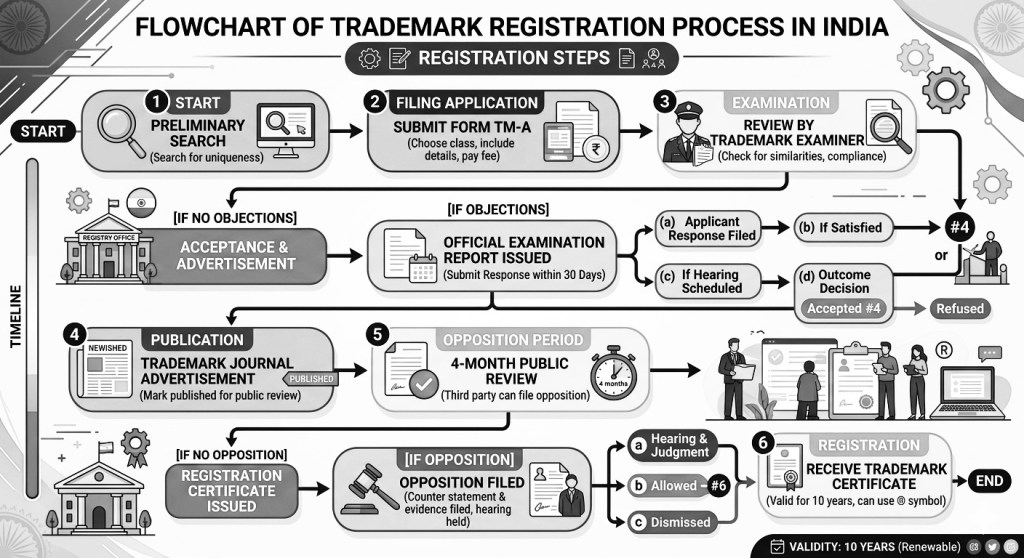
The entire Trademark Registration Process often ends up being much more complex than generally understood and might require legal attention at various stage of the process. Following are the various stages in concise form for better understanding.
Trademark Search: The process begins with a trademark search on the official IP India website to check whether the proposed mark is unique and not already in use. This step helps avoid conflicts and saves time during registration.
Trademark Application: Once the search confirms availability, the next step is to file a trademark application in form TM-A online or offline with the Trade Marks Registry by submitting the applicant’s details, class number in which goods or services belongs, and a clear representation of the trademark alongwith govt. fees. The govt. fees differs according to the category in which the Applicant belongs to. For Individual/Startup/Small enterprise the govt. fees for online filing is ₹ 4,500/- and for other cases it is ₹ 9,000/-
Examination & Objection: After filing, the application goes through examination by the Registrar, who checks for compliance with legal provisions and identifies any similarity with existing trademarks. If objections arise, the applicant must submit a legally sound written reply and if required also attend a hearing to clarify their case.
Publication & Grant: Once the application passes this stage, it is published in the Trade Marks Journal for a period of four months. This allows third parties to file an opposition if they believe the mark infringes on their rights. If no opposition is filed, or if the matter is resolved in favor of the applicant, the trademark proceeds to registration.
Registration & Renewal: On successful registration, the applicant receives a trademark registration certificate, granting them exclusive rights to use the mark for the specified goods or services. The trademark remains valid for 10 years from the date of application and can be renewed indefinitely in further blocks of ten years with timely renewal applications.
Before going further, let’s glance at Why Trademark Registration Gets Rejected:
•Incorrect class selection
•Weak or descriptive marks (Section 9 issues)
•Similar existing trademarks (Section 11 conflicts)
•Improper trademark search
•Filing under wrong applicant name (individual vs entity mismatch)Common mistakes at each stage that can hinder your trademark registration:
At Search Stage
- Relying only on basic public search
- Ignoring phonetic similarity
At Filing Stage
- Wrong class selection
- Improper description of goods/services
At Examination Stage
- Poorly drafted objection replies
- Missing deadlines
At Opposition Stage
- Ignoring published opposition notices
- Not responding within statutory period
Information Required for Filing a Trademark Application:
Hence, trademark application in India typically proceeds to registration over a span of roughly six to seven months, subject to procedural compliance and absence of objections or oppositions.
To initiate a trademark application in India, the following particulars and documents are required:
Core Requirements
- The trademark, logo, or word mark proposed for registration
- Details of the applicant, including name, address, and nationality; in the case of a company, the jurisdiction of incorporation
- Nature of the applicant entity, whether individual, startup/small enterprise, or other entity category
- The relevant class along with a clear specification of goods or services
- A duly executed power of attorney in favour of the authorised representative
Additional requirements in case of prior use or convention applications
- The date on which the trademark was first used in India, where prior use is claimed
- An affidavit affirming such prior use, supported by documentary evidence establishing commercial use of the mark
- Priority claim details, including application number, filing date, and country of origin, where applicable
- A certified copy of the priority document in convention-based filings
Clarification on formal documentation:
Affidavit of Use
Under the Trade Marks Rules, 2017, any application asserting prior use must be accompanied by a sworn affidavit substantiating such use. This affidavit must be filed together with documentary evidence demonstrating actual and continuous use of the mark in relation to the specified goods or services in India.Power of Attorney
A power of attorney authorising representation is required at the time of filing. This document may be executed by any duly authorised signatory of the applicant entity. Notarisation or legalisation is not mandated.Priority Documents
Where a priority claim is invoked based on a convention application, a certified copy of the priority document must be submitted. In the event of non-submission at the time of filing, the Trade Marks Registry may issue a formal notice requiring submission within the prescribed period.Registering a trademark not only provides legal protection but also helps in building brand recognition, consumer trust, and a stronger market presence. For entrepreneurs, startups, and established companies alike, understanding how to register a trademark in India is essential for long-term brand security.
-
Free Speech, Criminal Thresholds, and Judicial Control
With increasing instances of criminal proceedings arising out of social media expression, the boundary between protected speech and penal liability has become both contested and consequential. The question is no longer abstract, it is doctrinal, where exactly does the law draw the line between expression and offence. The Supreme Court’s decision in Imran Pratapgadhi v. State of Gujarat (2025) engaged directly with this question. At its core, the case tests whether criminal law can be invoked against poetic expression without satisfying the essential elements embedded in both the Constitution and penal statutes.
The prosecution arose from a video posted on social media containing a poem, which was alleged to promote communal disharmony, affect national unity, and hurt religious sentiments. The High Court declined to interfere at the threshold, relying primarily on the pendency of investigation. The Supreme Court was therefore required to determine whether, even on a plain reading of the material, the statutory ingredients of the alleged offences were disclosed.
The Court’s analysis is firmly anchored in the constitutional structure of Article 19. While Article 19(1)(a) guarantees freedom of speech and expression, restrictions under Article 19(2) operate as narrowly tailored exceptions. This structural hierarchy informs the interpretation of all speech-related offences, which cannot be applied in a manner that dilutes the primacy of the right itself.
Against this backdrop, the Court examined the relevant provisions of the Bharatiya Nyaya Sanhita, particularly Sections 196, 197, and 299. A consistent doctrinal thread runs through these provisions, criminal liability arises only where speech is directed against identifiable groups on protected grounds, carries a real tendency to create enmity or disturb public order, and is accompanied by the requisite intention. Mere offensiveness, dissent, or strong expression does not satisfy this threshold.
Applying this framework, the Court undertook a contextual reading of the poem and found no reference to any religion, caste, or community, no incitement to violence, and no material indicating an intention to promote disharmony. The expression, read as a whole, conveyed resistance to injustice through non-violence. On this basis, the Court held that none of the alleged offences were attracted.
In doing so, the Court reaffirmed two critical interpretive safeguards. First, speech must be evaluated from the standpoint of a reasonable, firm-minded individual, not through the lens of hypersensitivity or subjective offence. Second, mens rea remains indispensable in speech offences, intention cannot be presumed from isolated or strained readings of the content.
The judgment also carries important procedural implications. Interpreting Section 173(3) of the BNSS, the Court emphasised that in offences punishable up to seven years, particularly those involving speech, the police are empowered to conduct a preliminary inquiry to determine whether a prima facie case exists. This mechanism is not merely procedural, it serves as a constitutional safeguard against the mechanical invocation of criminal law in matters of expression.
Equally significant is the Court’s rejection of the view that the stage of investigation limits judicial intervention. Where the basic ingredients of an offence are absent on the face of the record, the continuation of proceedings itself constitutes an abuse of process. In such cases, the High Court is not only empowered, but obligated, to intervene at the threshold.
The decision thus restores doctrinal clarity in an area increasingly susceptible to overreach. By insisting on strict adherence to statutory ingredients, contextual interpretation, and the centrality of intent, the Court repositions criminal law within its legitimate domain, the regulation of harm, not the policing of disagreement.
At a broader level, the judgment underscored a constitutional caution. If speech offences are allowed to operate on subjective perceptions of offence or speculative harm, the exception under Article 19(2) risks subsuming the guarantee under Article 19(1)(a). The discipline imposed by this decision lies precisely in preventing that inversion.
-
Delhi HC on Injunctions When Patent Granted Is Near Expiry [Pharma Litigation]
In Pharma patent disputes the closer a patent moves towards expiry, the more pressing becomes the question whether injunctive relief continues to serve any meaningful legal purpose.
The issue before the Delhi High Court Division Bench was whether refusal of interim injunction in a patent infringement action warranted appellate interference, where a validity challenge had been raised and the patent was nearing expiry.
Essential Facts
The appellant asserted infringement of its patent covering Semaglutide. The respondents did not seriously contest acts amounting to infringement, but resisted relief by invoking invalidity under Section 64.
The learned Single Judge found a credible challenge to validity and declined injunction. By the time of appeal, the patent had approximately two months of life remaining.
The governing principles are settled:
•defendant may rely on any ground under Section 64 as a defence under Section 107
•At the interim stage, a credible challenge suffices
•Appellate review of such orders is limited by the Wander standard, permitting interference only where discretion is exercised perversely or contrary to law.
The analysis engages:
- Section 48, conferring exclusive rights
- Section 64(1)(a), (e), (f), governing revocation
- Section 107(1), incorporating these grounds as defences
The Court underscores a critical distinction, Section 64(1)(a) requires strict claim identity, whereas Sections 64(1)(e) and (f) operate through broader concepts of anticipation and obviousness.
Court’s Reasoning
The Court declines interference on two interlinked grounds.
First, applying the Wander principle, it finds no error in the exercise of discretion by the Single Judge.
Second, it affirms that a credible challenge to validity exists under Section 64(1)(f). The prior art disclosed the structural framework from which the claimed invention could be derived through a substitution already contemplated within its teaching. This, in the Court’s view, rendered the invention prima facie obvious to a person skilled in the art, or more appropriately, a “person in the know”.
Crucially, the Court introduces an additional consideration. With the patent on the verge of expiry, the grant of injunction would yield no substantive or enduring benefit, thereby undermining the claim of irreparable harm.
The judgment performs two important clarificatory functions.
It restores doctrinal precision by separating anticipation by prior claiming from obviousness, rejecting any attempt to collapse the former into an enabling disclosure analysis.
More significantly, it recalibrates the application of interim relief principles. While not altering the established triad governing injunctions, the Court integrates proximity to patent expiry into the assessment of irreparable injury and balance of convenience. This marks a shift from purely rights-based enforcement towards a more context-sensitive exercise of discretion.
The decision leaves open questions as to the extent to which proximity to expiry should systematically influence interim relief. It does not delineate whether such reasoning is confined to exceptional cases or capable of broader application.
Further, the relationship between residual patent value and equitable protection remains unexplored, particularly in high-value pharmaceutical markets.
The immediate consequence is a heightened threshold for obtaining interim injunctions in late-stage patent life. Patent holders may find exclusivity increasingly difficult to enforce as expiry approaches, especially where defendants can articulate a plausible invalidity challenge.
For defendants, the decision reinforces the strategic value of raising credible, even if not conclusive, validity objections at the interlocutory stage.
The judgment does not dilute patent rights, but places their interim enforcement within a framework that accounts for timing, utility, and judicial economy.
In doing so, it affirms that interlocutory relief in patent law is not merely a function of entitlement, but of contextual justification.
Leave your suggestion and comments on WhatsApp no. +91-8929203324
-
Dominant Feature and Phonetic Similarity in Composite Trade Marks
The dispute in Asian Paints Limited v. Tarun Paints Private Limited [Delhi High Court Judgment (2026)] arose from allegations by Asian Paints Limited that the mark “ASIA TUFF,” used by Tarun Paints Private Limited, infringed its registered trademark “ASIAN PAINTS.” The plaintiff contended that the word “ASIAN” constituted the dominant and distinctive element of its composite mark and that the defendant’s adoption of the word “ASIA” represented a deliberate approximation designed to capitalise on the goodwill attached to the plaintiff’s brand.
The case required the court to apply the settled test of deceptive similarity, namely whether an average consumer with imperfect recollection would likely be misled by the defendant’s mark. While composite marks must generally be evaluated in their entirety, the court reiterated that particular emphasis may be placed on the dominant or essential feature of a mark, especially where other components are descriptive in nature.
Within this framework, the phonetic and visual proximity between the words “ASIAN” and “ASIA” became central to the dispute. Given that both parties operated in relation to identical goods, namely paints and allied products, the court examined whether the similarity in the principal element of the marks could create a likelihood of confusion or association in the marketplace.
The judgment thus reinforces a familiar strand of Indian trademark jurisprudence: the assessment of similarity is ultimately contextual and consumer-centric. Even relatively small variations in wording may assume significance where the dominant feature of a well-known mark is reproduced in a competing mark used for the same class of goods
-
Calcutta High Court On Whether The Patent Office Can Merge Examination and Pre-Grant Opposition? And How This Impacts Future Pre Grant Oppositions
The judgment in UPL vs Haryana Pesticides (2026), decided on 5 February 2026 by the Calcutta High Court’s Intellectual Property Rights Division, examines a crucial procedural question under the Patents Act, 1970 arising from the rejection of UPL’s patent application for “Herbicidal Combinations” following a pre-grant opposition. The Court set aside the rejection order on grounds of procedural impropriety and violation of natural justice, and remanded the matter for fresh consideration. This judgment reinforces the structural separation between patent examination and pre-grant opposition proceedings, clarifies that a requested Section 14 hearing cannot be bypassed for administrative convenience, and firmly reiterates that reasoned, independent decision-making is foundational to patent adjudication in India.
The central issue was whether the Controller of Patents could dispose of examination proceedings under Sections 14 and 15 and pre-grant opposition proceedings under Section 25(1) of the Patents Act through a single composite order, without granting separate hearings. The Court had to determine whether such a procedure violated the statutory scheme of the Act and the principles of natural justice.
The judgment clearly demarcates the distinction between examination proceedings and pre-grant opposition proceedings. It reinforces that procedural safeguards under the Patents Act are mandatory and clarifies the limited role of a pre-grant opponent in patent examination. It strengthens the requirement that quasi-judicial patent decisions must be reasoned and speaking orders and it serves as an important precedent for patent prosecution and opposition practice in India.
Facts:
UPL Limited filed a patent application on 26 March 2018 titled “Herbicidal Combinations”. The application was published on 27 September 2019 and First Examination Report was issued on 24 January 2020. Thereafter UPL filed its response to the FER on 22 July 2020 and specifically requested a hearing under Section 14.
Respondent No. 1 filed a pre-grant opposition under Section 25(1) on 30 September 2020. Additional prior art documents D3 to D5 were introduced in the opposition, which were not part of the FER. A hearing on the pre-grant opposition and a single composite order dated 27 April 2023 rejected the patent application on grounds of lack of novelty, lack of inventive step, and Section 3(e) being a mere admixture.
UPL challenged this rejection before the Calcutta High Court and the issues Before the Court included:
Whether examination proceedings under Sections 14–15 and pre-grant opposition proceedings under Section 25(1) are distinct statutory stages.
Whether the Controller was required to grant separate hearings under Section 14 and Section 25(1).
Whether passing a composite order violated the scheme of the Patents Act.
Whether failure to supply prior art D4 and consideration of new prior arts without adequate opportunity violated natural justice.
Whether the impugned order was a valid speaking order with independent reasoning.
Whether a pre-grant opponent has a right to participate in examination proceedings.
The Decision:
The Court held that Sections 14–15 (examination stage) and Section 25(1) (pre-grant opposition stage) are distinct and independent proceedings under the Patents Act, 1970. The statutory scheme does not contemplate merger of these processes
Since the appellant had expressly requested a hearing under Section 14, the Controller was obligated to grant it. Failure to do so and passing a combined order constituted procedural impropriety. The Court relied upon S.N. Mukherjee vs Union of India, where the Supreme Court held that recording reasons is an essential facet of natural justice in quasi-judicial decisions.The High Court found that the Controller’s order lacked independent reasoning and mechanically adopted the opponent’s submissions. The Court relied heavily on Novartis AG vs Natco Pharma Limited, which clarified that the examination process is an independent statutory duty of the Controller. A pre-grant opponent has a right of hearing only in opposition proceedings. The opponent cannot claim participatory rights in the examination process. The two processes must remain structurally distinct. The Court also referred to Gilead Pharmasset, LLC vs Union of India & Anr., which emphasised that procedural violations affecting natural justice justify setting aside patent decisions.
The Court concluded that the composite order failed to demarcate findings under Sections 15 and 25(1). The applicant was prejudiced by consideration of additional prior art without separate hearing. The matter required fresh adjudication. The appeal was allowed and the impugned order dated 27 April 2023 was set aside. The matter was remanded to a different Controller. Fresh hearing under proper statutory procedure was directed. The Court did not decide patentability on merits.
Impact on other pending pre-grant oppositions includes:
Mandatory Hearing Separation: The ruling establishes that if a patent applicant expressly requests a Section 14 hearing(examination stage), the Controller cannot bypass it by only holding a combined pre-grant opposition hearing. Pending cases where such a request was made but ignored are now highly vulnerable to being set aside on appeal.
Identifiable Findings: Even if a “common order” is passed for administrative ease, it must now clearly demarcate which portions relate to Section 15 (rejection by the Office) and which relate to Section 25(1) (opposition by a third party). Orders that conflate these findings can be challenged as lacking independent reasoning.
Introduction of New Prior Art: The court highlighted that introducing new prior art during the opposition stage requires a fair rebuttal opportunity for the applicant. Pending oppositions where new evidence was introduced without a chance for the applicant to amend claims or provide separate data are likely to be remanded for fresh consideration.
Share your thoughts on WhatsApp +91-8929203324
-
Supreme Court On Fixing Minimum Wages Of Domestic Workers
Does the Constitution guarantee minimum wages to domestic workers? The Supreme Court answered this in 2026. In Thozhilalargal Sangam & Ors. v. Union of India & Ors. [W.P.(C) No. 42/2026], case filed with the aim that Domestic workers should be covered under minimum wage laws. That minimum wages should be declared a fundamental right, directions be issued to Centre and States to fix wages and grant protection under labour laws
On 29 January 2026, a Bench comprising Chief Justice Surya Kant and Justice Joymalya Bagchi ruled that implementing minimum wages is a legislative and executive matter best left to State authorities.
The Apex court while observing that domestic workers are vulnerable reasoned that wage fixation is a legislative function and courts cannot force law-making, while the policy decisions lie with Parliament and States
The Court expressed concern that mandatory wage fixation for households could lead to trade unions dragging “every household” into litigation, potentially discouraging people from hiring domestic help
Supreme Court refused to fix minimum wages, did not declare it a fundamental right and the petition disposed of
Share you opinion with the author by leaving a WhatsApp message on +91-8929203324
-
Supreme Court On Whether Insolvency Tribunals Can Decide Trademark Ownership Disputes
A recent Supreme Court judgment dated 22nd January 2026, involving the trademark “GLOSTER” has brought crucial clarity on whether insolvency tribunals can decide trademark ownership disputes. The ruling draws a clear boundary between insolvency resolution under the IBC and independent civil rights under trademark law, making it an important decision for businesses, insolvency professionals, and IP practitioners alike.
The dispute arose from the long and complex relationship between Fort Gloster Industries Limited (FGIL) and Gloster Cables Limited (GCL). FGIL was the original registered owner of the trademark “GLOSTER”. Over time, FGIL allowed GCL to use the trademark under collaboration and licensing agreements. FGIL eventually stopped its manufacturing operations and later became financially distressed, leading to proceedings before the Board for Industrial and Financial Reconstruction. During this period, FGIL entered into multiple arrangements with GCL, including exclusive licensing, creation of charge over the trademark as security for a loan, and a future-oriented agreement contemplating assignment of the trademark once statutory restrictions were lifted.
After the BIFR regime ended, FGIL executed a deed assigning the trademark to GCL, and GCL was subsequently recorded as the registered proprietor in the Trademark Registry. Around the same time, insolvency proceedings under the Insolvency and Bankruptcy Code were initiated against FGIL. A resolution plan submitted by Gloster Limited was approved by the Committee of Creditors. However, the plan acknowledged that ownership of the trademark “GLOSTER” was disputed and subject to existing agreements in favour of GCL.
The conflict intensified when GCL approached the NCLT seeking exclusion of the trademark from the resolution plan, asserting that the trademark no longer belonged to FGIL. The NCLT rejected this claim and went further to declare that the trademark was an asset of FGIL, thereby vesting it in the Successful Resolution Applicant. This declaration was overturned by the NCLAT, which held that the insolvency tribunal had exceeded its jurisdiction. The matter ultimately reached the Supreme Court through cross appeals.
The Supreme Court ruled that the NCLT had no authority to conclusively decide trademark ownership under Section 60(5) of the IBC. The Court emphasised that insolvency tribunals are meant to resolve issues arising directly from insolvency, not to adjudicate complex civil disputes involving title, contractual interpretation, and intellectual property rights. Trademark ownership, the Court held, is a substantive civil right that exists independently of insolvency proceedings.
A key part of the Court’s reasoning was that the approved resolution plan itself did not clearly vest ownership of the trademark in FGIL or the Resolution Applicant. Instead, it recorded competing claims and merely expressed a belief that agreements in favour of GCL were invalid. The Court clarified that such beliefs cannot be converted into declarations of ownership by the NCLT. Once a resolution plan is approved by creditors, the adjudicating authority cannot rewrite or improve it by granting additional substantive rights.
The Court also noted that if the assignment of the trademark was alleged to be illegal, preferential, or undervalued, the Insolvency Code provides specific mechanisms for avoidance proceedings. No such proceedings were initiated by the Resolution Professional. In the absence of these statutory actions, the NCLT could not invalidate the assignment or decide title by default.
The Supreme Court clarified that the judgment made it clear that trademark ownership disputes must be decided by competent civil or commercial courts, or through statutory remedies available under the Trade Marks Act, 1999. Insolvency tribunals cannot be used as shortcuts to settle long-standing intellectual property disputes.
In conclusion, the Supreme Court’s ruling draws a firm jurisdictional line between insolvency law and intellectual property rights. While insolvency proceedings can determine how assets of a corporate debtor are resolved, they cannot be used to decide disputed ownership of trademarks or other independent civil rights.
-
Copyright Versus Moral Rights Versus Performers Right
A creator must know these concepts to protect their rights. So I’m going to breakdown the concept of what is copyright moral right what is performers right under the Indian Copyright Act 1957 with examples for your better understanding.
Copyright
Let’s begin with the concept of copyright and the concerning main sections are section 13 and 14 under the Indian Copyright Act.
What is the concept of copyright? In simple words it means legal ownership over your original creative work which in most cases will last for the lifetime of the creator plus further specified years depending on the category of work. Various works are put under different categories such as literary category, dramatic, musical, artistic, cinematograph film, sound recording.

For example, architectural drawing come under artistic category. Software program are special category and come under literary category.
Rights Conferred By Copyright
Copyright gives the creator of an original work exclusive rights in relation to the work and prohibit others from infringing such rights. Copyright holder has sole legal authority to reproduce the work, to publish or distribute it, to sell or license to monetise and adapt or remix the work, and to perform it in public.
In relation to copyright, please note that the moment you create your original work, you already hold a copyright over it, there is no mandatory requirement under law to register your copyright. But the moment any kind of dispute arises and you need to prove your right, that is when registration comes to your aid, registration makes copyright legally enforceable in disputes and it goes in your favour. It is always advisable to be careful and get your work registered.
Moral Rights
Moving on to the next concept that is moral rights, what is the section of copyright act dealing with this right? It is section 57 which specifies moral rights. So. Let’s understand what moral rights mean?
Even if you assign your copyright or license it, or copyright time period expires, section 57 gives you rights known as moral rights which can never be taken away. Moral rights come under two categories, they are “right of paternity” and “right off integrity”.
Right of Paternity
It means to be credited as the original creator. For example, if you are a singer or a writer of a novel, you will always be identified as their creator or author even when the copyright is over or copyright is assigned to someone else. This is your basic right of paternity you will always be associated as the author of that work.
Right of Integrity
It means you have the right even after assigning your copyright to stop someone from distorting your work or modifying your work or misusing your work that can harm your reputation. For example, being an author of a novel you have assigned your rights for it to be made into a motion picture, you still have the right to stop the distortion of your work which will harm your reputation as the creator of that work.
After the concept of copyright and moral rights let’s move on to the next concept that is performer rights.
Performers Rights
Relevant sections? Section 38, 38 A, and 38 B of the Copyright Act.
If you perform live, such as sing or dance or act or other live performances, you are protected under these section of the Indian Copyright Act. For example, you are giving live musical performance and someone records your live performance and uploads it, you can claim ownership , demand payment, and get it blocked.
Hence, unauthorised recording and uploading and streaming without your permission or using your live performances commercially without paying you, these are prohibited and you have rights as a performer to take legal recourse against such accents.
Hence, Copyright Act can be said to be equivalent to ownership and monetisation rights. Moral rights give you credit as well as respect for your work, Performer rights give you control over usage of your life performance.
So, be aware of your rights and protect your art, protect your name, and protect your future.
To contact the author or leave suggestions drop a WhatsApp message on +91-8929203324 or email at info@lawipandmore.in
Laws…Analysis…Updates…And More
 LAW-IP AND MORE